Nivaan Logo

Epidural Injection Treatment in Mumbai | Image-Guided Spine Pain Relief

Not all epidural injections are the same procedure done one way, interlaminar, transforaminal, and caudal approaches target the epidural space from different points, and choosing the right one for your specific pain pattern matters as much as the injection itself. If you're researching epidural injection treatment in Mumbai for a herniated disc, spinal stenosis, or radiating leg pain, this page walks through all three approaches, what a realistic recovery looks like, and one detail worth checking before you book anywhere: whether image guidance is actually being used.
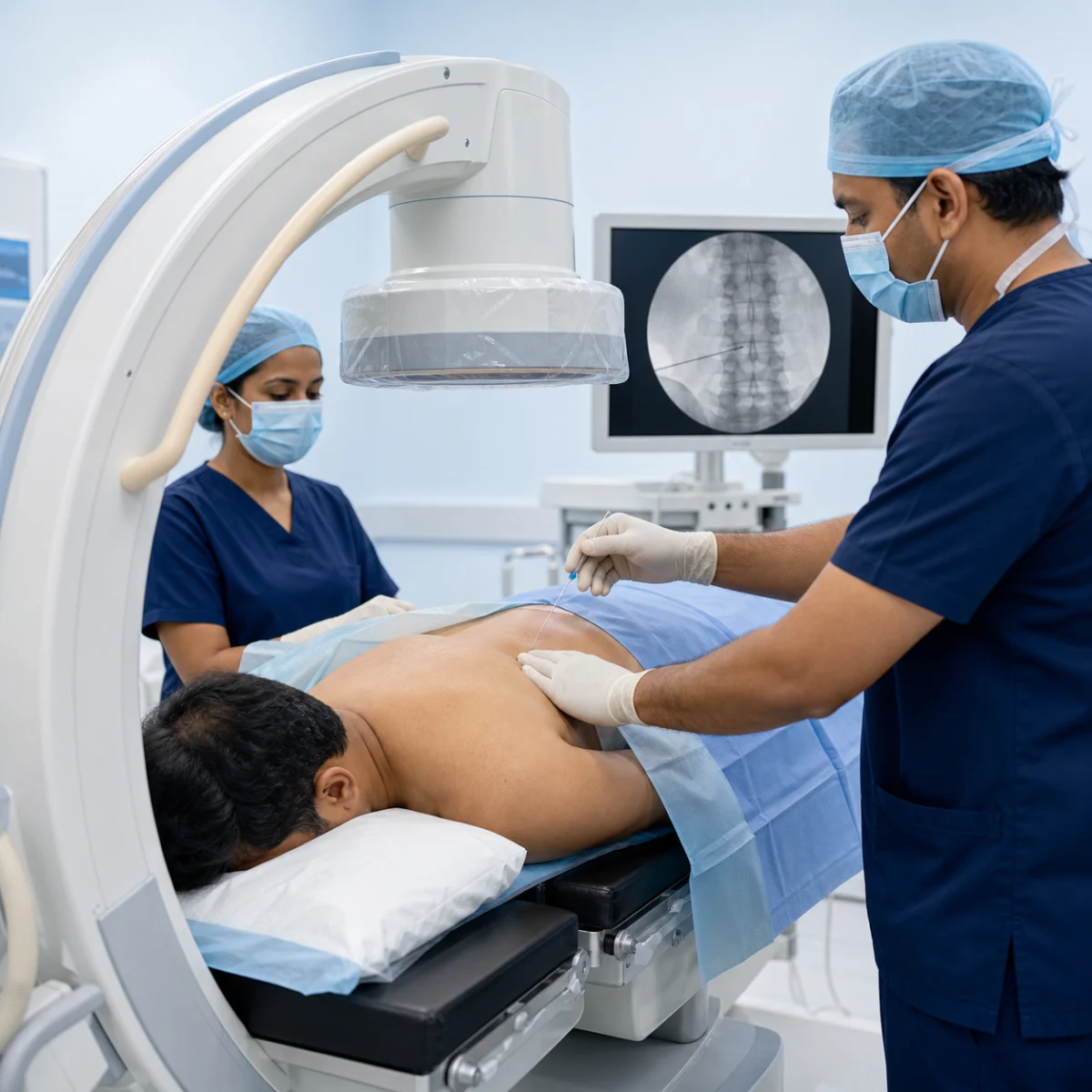
Fluoroscopy-guided lumbar epidural steroid injection performed by an interventional pain specialist

0

patients treated

0

advanced non-surgical procedures

0

years of combined expertise

Treatment Overview

What Is an Epidural Injection?

An epidural injection, also called an epidural steroid injection (ESI), is a minimally invasive spinal injection that deposits a precise combination of corticosteroid and local anaesthetic into the epidural space, the narrow channel surrounding the spinal cord and nerve roots inside the vertebral column.

When a disc herniates, a nerve root becomes compressed, or the spinal canal narrows (stenosis), the resulting inflammation causes intense pain that radiates along the nerve pathway, into the leg as sciatica, into the arm, or across the back. Epidural injection delivers a corticosteroid directly to this site of inflammation, suppressing the inflammatory cascade at the nerve root level and providing meaningful, often long-lasting pain relief, without surgery, general anaesthesia, or hospitalisation.

Treatment Guide

How Does an Epidural Steroid Injection Work?

When a disc herniates or a nerve root is compressed, the body releases inflammatory mediators that sensitise the nerve root and cause radicular pain. Corticosteroid injected into the epidural space suppresses this inflammatory cascade directly at the source, reducing oedema around the affected nerve root, decreasing neural sensitisation, and interrupting the pain cycle, allowing the patient to engage meaningfully with physiotherapy.

Image guidance matters more than many patients realise: studies consistently show that without imaging guidance, up to 30-40% of epidural injections miss the intended target, even in experienced hands. Epidural injection at Nivaan is always performed under fluoroscopic or ultrasound image guidance, ensuring the medication reaches the exact epidural level where the inflammation is occurring, not an approximation.

Treatment Guide

Types of Epidural Steroid Injections

The needle is inserted between two adjacent vertebral laminae. The most widely used approach for generalised disc-related back pain and bilateral symptoms, delivering medication across a broader area.

  • Transforaminal (TFESI) - The needle is directed into the intervertebral foramen where the nerve root exits, delivering steroids closest to the nerve root. The most targeted approach for single-level radiculopathy (sciatica from a specific disc level), with the strongest evidence base for this indication.
  • Caudal - Accesses the epidural space via the sacral hiatus at the base of the spine. Particularly useful for lower lumbar and sacral nerve root pain, post-surgical patients with altered anatomy, and elderly patients. Technically simpler, with lower dural puncture risk.

Your specialist will select the approach that best matches your imaging findings and pain pattern.

Treatment Guide

Conditions Treated with Epidural Injection in Mumbai

  • Sciatica and lumbar radiculopathy - Radiating leg pain, numbness, or weakness from a compressed lumbar nerve root.

  • Herniated or slipped disc - Disc material pressing against a nerve root, causing local and referred pain.
  • Spinal stenosis - Narrowing of the spinal canal compressing multiple nerve roots, causing bilateral leg pain and difficulty walking.
  • Degenerative disc disease - Age-related disc changes causing localised and radicular pain.
  • Post-surgical back pain - Persistent pain after spinal surgery, often from nerve root scarring.
  • Cervical radiculopathy - Nerve root pain radiating into the arm, shoulder, or hand from a compressed cervical disc.
  • Vertebral compression fracture pain - Where nerve inflammation is a component of the pain.
Treatment Guide

Who Is a Suitable Candidate?

Epidural injection may be the right option if you have:

  • Radiating nerve pain lasting more than 4-6 weeks despite conservative treatment
  • Confirmed disc herniation, nerve compression, or spinal stenosis on MRI
  • Pain not adequately responding to physiotherapy, NSAIDs, or oral steroids
  • A wish to avoid or delay surgery, where clinically appropriate
  • A need for pain relief sufficient to enable active physiotherapy

Generally not recommended for active spinal infection, uncontrolled bleeding disorders, uncontrolled diabetes, first-trimester pregnancy where fluoroscopy is involved, active cancer at the injection site, or known allergy to corticosteroids or contrast dye.

Best Doctors for Epidural Injections in Mumbai

Treatment Guide

The Epidural Injection Procedure, Step by Step

Before the procedure:

  • Review of your medical history, medications, and imaging
  • Pausing blood thinners and NSAIDs for 7 days, only on medical advice
  • Disclosing allergies, particularly to iodine contrast dye
  • Diabetic patients advised that blood glucose will be monitored, since corticosteroids cause a temporary rise

What happens during treatment:

  • Positioning - You lie face down with a pillow supporting your abdomen.
  • Sterile preparation - The injection site is cleaned, draped, and numbed with local anaesthetic.
  • Image guidance setup - Fluoroscopy or ultrasound provides live imaging throughout.
  • Epidural needle placement - The needle is advanced under continuous image guidance; contrast dye confirms correct placement before medication is given.
  • Injection - The corticosteroid and local anaesthetic solution is slowly injected, taking 20-40 minutes total.
  • Recovery and discharge - You rest for 20-30 minutes; most patients go home the same day.
Treatment Guide

Recovery and Aftercare

A temporary increase in pain or a brief flare in nerve symptoms in the 24-48 hours after the injection is normal, it indicates correct needle placement and that the medication is working, not a complication.

TimeWhat to Expect
Immediately afterMild soreness; possible temporary leg heaviness from local anaesthetic
First 24-48 hoursPossible brief pain flare as steroid begins working
Days 3-7Local anaesthetic fades; steroid effect begins to build
Weeks 1-4Progressive reduction in nerve pain
Weeks 4-12Maximum steroid effect; window for active physiotherapy
Months 3-6Duration of relief varies; many maintain meaningful benefit

Diabetic patients should monitor blood glucose closely for 3-5 days post-injection. Epidural injection at Nivaan is always combined with structured physiotherapy, the injection provides the pain window; physiotherapy builds the strength that prevents recurrence.

Treatment Guide

Benefits, Risks, and Side Effects

Benefits

  • Targets the root cause - Delivers anti-inflammatory medication directly to the compressed nerve root
  • Image-guided precision - Confirms correct placement before injection, a standard not met by freehand injection
  • Non-surgical - No incisions, general anaesthesia, or hospital admission
  • Rapid pain relief - Many patients notice improvement within days to weeks
  • Repeatable - Can be administered up to three times per year when clinically appropriate

Risks and Side Effects

  • Temporary soreness or bruising - Settles within 1-3 days
  • Brief post-injection flare - Normal, settles within 48 hours
  • Temporary facial flushing - Settles within 24 hours
  • Short-term blood glucose elevation - Important for diabetic patients to monitor
  • Temporary headache - If the dura is inadvertently punctured, managed with rest and hydration
  • Rare infection or bleeding - Minimised by sterile technique; bleeding risk elevated in patients on anticoagulants

Serious complications, including nerve damage or paralysis, are exceptionally rare when performed under image guidance by an experienced specialist at Nivaan

Treatment Guide

Epidural Injection Cost Considerations in Mumbai

Cost varies depending on the approach used (interlaminar, transforaminal, or caudal), the spinal level treated, the number of levels injected, and whether fluoroscopic image guidance is included. Given the real risk of unguided injections missing their target entirely, confirming that image guidance is included in any quoted price is worth asking about directly, a lower price without imaging guidance may not represent genuine value.

Treatment Guide

Results and Number of Sessions

Clinical evidence shows ESI provides significant short-term pain relief in at least half of patients, with many maintaining benefit for 3-6 months.

  • Days 3-7 - First improvement as steroid effect builds
  • Weeks 1-4 - Meaningful nerve pain reduction
  • Weeks 4-12 - Maximum benefit and rehabilitation window
  • 3-6 months - Duration of relief in most responders; some maintain benefit beyond 12 months

Transforaminal epidural injection for acute single-level radiculopathy consistently shows the strongest outcomes. Patients with chronic, long-standing compression tend to see more limited benefit.

Treatment Guide

Why Choose Nivaan Care for Epidural Injection in Mumbai?

Epidural InjectionNivaan CareStandalone Injection
Who performs itInterventional pain specialist under fluoroscopic guidanceGeneral practitioner or clinic
DiagnosisExact spinal level confirmed before treatmentSymptom-based
Injection techniqueFluoroscopy-guided with contrast confirmationFreehand or landmark-based
Approach selectionInterlaminar/transforaminal/caudal chosen per diagnosisSingle approach used for all
RehabilitationPersonalised physiotherapy post-injectionNone
Follow-up careStructured, ongoing recovery planRarely structured
FAQs

Frequently Asked Questions

They're completely different procedures. Labour epidural anaesthesia uses a continuous catheter and high-dose local anaesthetic to block sensation during childbirth. An epidural injection for back pain uses a single-shot injection of corticosteroid and low-dose local anaesthetic targeted to a specific spinal level to reduce nerve inflammation.
Three main approaches: interlaminar (midline entry, best for bilateral or multi-level pain), transforaminal/TFESI (entry through the nerve root foramen, strongest evidence for sciatica), and caudal (entry via the sacral hiatus, useful for lower lumbar and post-surgical pain).
Yes, generally. Side effects are typically mild and temporary. Serious complications are rare and significantly reduced by fluoroscopic image guidance.
Most patients experience meaningful relief for 3-6 months. Some maintain benefit beyond 12 months, particularly when combined with structured physiotherapy.
Yes, epidural injection is offered as part of Nivaan Care's non-surgical, interventional pain management approach for patients in Mumbai.
The most targeted form of ESI, the needle is guided into the intervertebral foramen, placing corticosteroid as close to the nerve root as possible. Particularly effective for single-level sciatica from a herniated disc.
Humidity, temperature changes, increased fall risk on wet surfaces, and reduced activity during heavy rain can all aggravate existing back conditions. A seasonal flare doesn't necessarily mean the underlying condition has worsened structurally, but it's a reasonable prompt to get properly assessed.
Call Us