

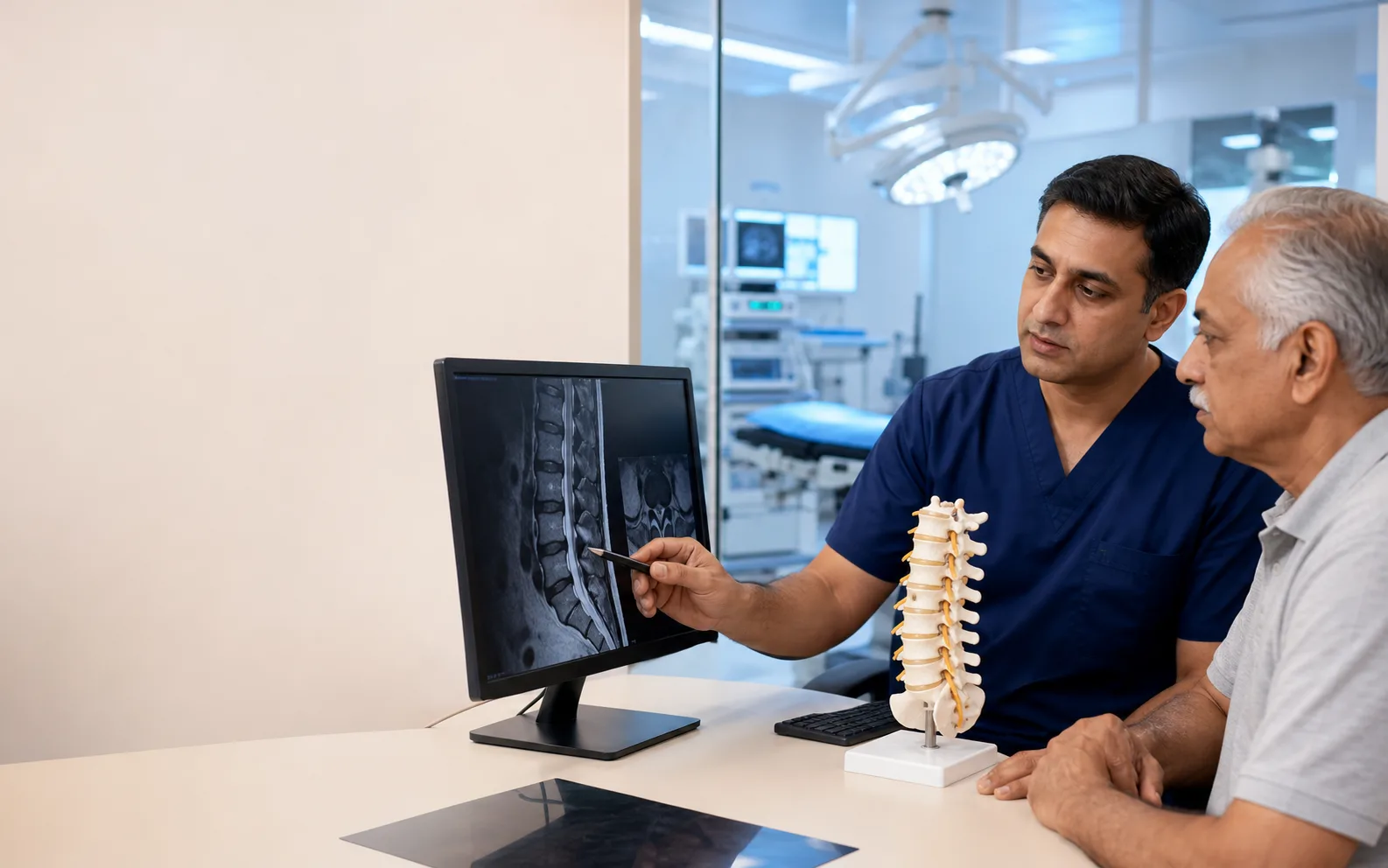
Transforaminal endoscopic decompression, accesses the spinal canal through the foramen, guided by fluoroscopy, often preferred for foraminal stenosis and lateral recess narrowing.
What Is Endoscopic Decompression?
Endoscopic decompression (also called endoscopic spinal decompression or minimally invasive lumbar decompression) relieves pressure on a spinal nerve or the spinal cord caused by spinal stenosis, through a single incision under 1 cm, using a camera and micro-instruments.
The key difference from a discectomy: decompression targets the bony and ligamentous narrowing that develops over years, thickened ligamentum flavum, bone spurs, enlarged facet joints, rather than a soft disc fragment. It's a degenerative problem, not an acute one, and the surgical approach reflects that.
Lumbar decompression is the most common, typically at L4–L5. Cervical decompression addresses stenosis and foraminal narrowing in the neck.
Endoscopic Decompression vs. Laminectomy vs. Foraminotomy vs. Discectomy
- Decompression -the broad term for any procedure that takes pressure off a compressed nerve root or spinal cord.
- Laminectomy/laminotomy -removes part or all of the lamina to widen the canal. Often the core step in a decompression.
- Foraminotomy -specifically widens the nerve's exit channel when that's where the narrowing is.
- Endoscopic discectomy -a separate procedure that removes herniated disc material. Sometimes done alongside decompression when both problems coexist, but not the same operation.
- Endoscopic decompression -accomplishes laminotomy or foraminotomy through a sub-1 cm incision, with less muscle disruption and a quicker recovery than open approaches.
- Microscopic (open) decompression -uses a surgical microscope through a larger incision (1.5–2 inches). Still the go-to for complex or multi-level stenosis in many centres.
Transforaminal vs. Interlaminar Approach
Interlaminar endoscopic decompression, accesses the canal through the lamina, offering a broader view of the central spinal canal, often preferred for central canal stenosis and certain L5-S1 cases.
Who Is a Candidate for Endoscopic Decompression?
Generally considered when:
Confirmed spinal stenosis on MRI or CT causing nerve root or spinal cord compression
Neurogenic claudication, leg pain, cramping, heaviness, or numbness that worsens with standing or walking and improves with sitting or bending forward
Symptoms persisting despite genuine conservative treatment
Physiotherapy, medication, and appropriate interventional options (such as epidural injections) haven't given adequate relief
Significant neurological symptoms, such as progressive weakness or bowel/bladder changes
Generally not suitable for:
Significant spinal instability, such as degenerative spondylolisthesis requiring fusion
Active spinal infection
Spinal tumours
Coagulation disorders or blood thinners that can't be safely paused
Extensive scar tissue from previous spinal surgery in the same area
Patients who haven't genuinely exhausted conservative treatment first
Best Doctors to Endoscopic Decompression in Mumbai


Diagnosis Before Considering Surgery
Spinal stenosis is a clinical and imaging diagnosis, you need both, not just one. An MRI shows where the canal has narrowed and which nerves are affected. A physical and neurological exam tells the specialist whether those imaging findings actually match your symptoms. The two together determine whether decompression makes sense or whether there's still meaningful ground to cover with conservative care.
The Non-Surgical Path First
At Nivaan, most patients with spinal stenosis do not need surgery. Our non-surgical approach typically includes:
- Structured physiotherapy and posture correction
- Medication and activity modification
- Image-guided epidural injections or nerve blocks to reduce inflammation around the compressed nerve
- A genuine trial period, with honest reassessment, not indefinite delay
If symptoms haven't improved after this genuine trial, or red-flag symptoms need more urgent action, that gets communicated plainly, with support toward the right surgical opinion.
What the Procedure Involves
Typically performed under regional or general anaesthesia, in an operating theatre, by a spine surgeon:
- STEP 1A small incision, usually under 1cm, is made over the affected level.
- STEP 2Using fluoroscopic guidance, a tubular retractor and endoscope are inserted to the target level.
- STEP 3The surgeon views the bone, ligament, and nerve root on an external monitor, carefully removing the thickened ligament, bone spur, or portion of lamina/facet causing compression.
- STEP 4If a co-existing disc herniation is also contributing, a limited discectomy may be performed at the same time.
- STEP 5The incision is closed, often with a single stitch or adhesive strip.
- STEP 6The procedure usually takes 1-2 hours, and many patients go home the same day or after one night's observation.
Endoscopic Decompression Recovery Time
| Time | What to Expect |
|---|---|
| First 24-48 hours | Light walking encouraged; rest otherwise |
| First week | Mild discomfort; pain medication as needed; avoid bending, twisting, or lifting |
| Weeks 2-4 | Physiotherapy typically begins; gradual increase in activity |
| Weeks 4-6 | Most patients return to desk-based work |
| Up to 3 months | Full recovery, including return to more strenuous activity, with surgeon's clearance |
Risks, generally lower than open surgery but not zero, can include infection, bleeding, nerve irritation, dural tears, incomplete symptom relief, recurrent stenosis at the same or adjacent level, or, less commonly, the need for a further stabilisation procedure.
Endoscopic Decompression Success Rate
You'll see success-rate percentages quoted across clinics online, often in the 80-90% range for meaningful improvement in leg symptoms and walking tolerance. These figures usually come from individual clinics' own case series rather than large, independent controlled trials, worth treating any single confident percentage with healthy scepticism. What's more reliably true: for well-selected patients with confirmed, appropriately located spinal stenosis who haven't responded to conservative care, endoscopic decompression has a strong track record of relieving neurogenic claudication, with meaningfully faster recovery than traditional open laminectomy.
Endoscopic Decompression Cost in Mumbai
Cost typically ranges from roughly ₹1,20,000 to ₹3,00,000-plus, depending on the hospital, surgeon, number of levels treated, and whether a concurrent discectomy is required. This is a broad market indication, not a Nivaan-specific quote. If your assessment points toward needing surgery, understanding realistic cost expectations is part of that conversation.
Endoscopic Decompression at Nivaan: Our Role, Honestly
Our interventional pain specialists diagnose your condition, deliver non-surgical and interventional treatment, and give an honest opinion on whether conservative care is working. Endoscopic decompression itself is a surgical procedure performed by a spine surgeon in an operating theatre. Where surgery is genuinely the right next step, that gets communicated clearly, with support in getting there, rather than either overselling non-surgical care past its usefulness or rushing toward surgery before it's time.
Why Start With Nivaan Before Considering Surgery?
Assessment starts with an accurate diagnosis, not a predetermined treatment path, an interventional pain specialist confirms your exact diagnosis, a physiotherapist builds a genuine rehabilitation plan, and a pain counsellor supports the anxiety that comes with persistent back or nerve pain.
Spinal Stenosis, Mobility, and Mumbai's Older Housing Stock
Spinal stenosis predominantly affects an older population, and for many older Mumbai residents, the practical stakes go beyond pain alone. Much of the city's older housing stock has no lift, meaning stairs are a daily, unavoidable requirement, and uneven pavements and crowded streets make walking genuinely harder when neurogenic claudication, leg pain or heaviness that worsens with standing or walking, starts limiting distance and confidence. For patients in this situation, the real question is rarely "do I want surgery," it's "how do I keep my independence and mobility," and that's exactly the conversation a proper diagnosis needs to start with.
Frequently Asked Questions
Most patients walk within a day, return to desk-based work within 4-6 weeks, and reach full recovery by around 3 months.
Clinics commonly quote 80-90% for meaningful improvement in leg pain and walking tolerance in well-selected patients, though these figures typically come from individual case series rather than large controlled trials.
Roughly ₹1,20,000 to ₹3,00,000 or more, depending on the hospital, surgeon, number of levels, and case complexity.
Many cases improve with conservative treatment, physiotherapy, medication, activity modification, and sometimes image-guided injections, without ever needing surgery.