

Transforaminal: reaches the disc through the foramen, the natural opening where the nerve root exits the spine, guided by live X-ray. This is the more common approach for lower back herniations.
What Is Endoscopic Discectomy?
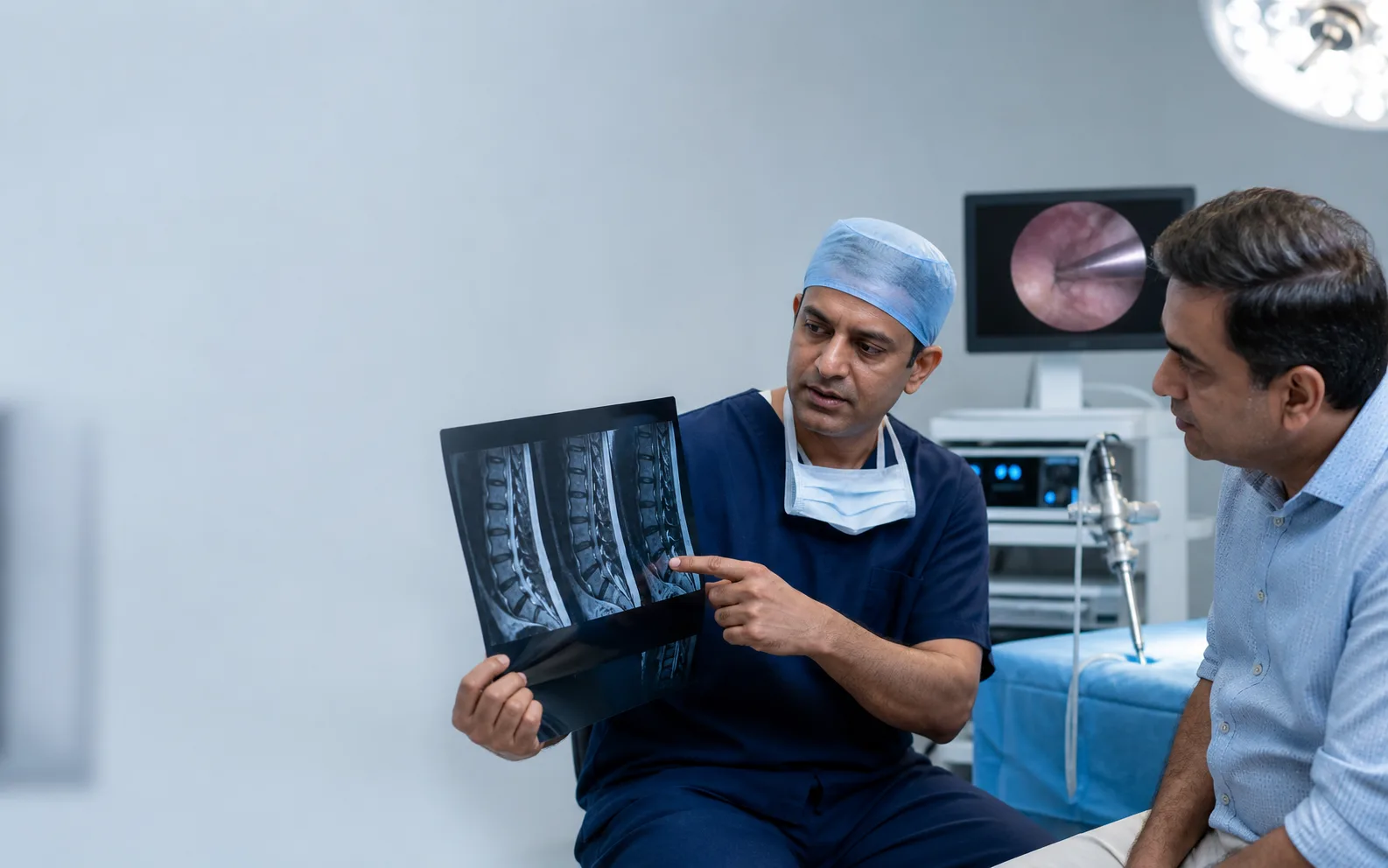
Endoscopic discectomy, also called endoscopic spine surgery, PELD surgery, or percutaneous endoscopic lumbar discectomy, removes the part of a herniated disc that is pressing on a spinal nerve. A thin tube carrying a tiny camera, along with fine surgical tools, works through a single cut usually under 1 cm.
Endoscopic lumbar discectomy treats herniations in the lower back, the most common site, often at the L4-L5 or L5-S1 levels. Endoscopic cervical discectomy treats herniations in the neck.
Endoscopic Discectomy vs Microdiscectomy vs Discectomy
- Discectomy: the general term for surgically removing disc material pressing on a nerve, whatever technique is used.
- Microdiscectomy: uses an operating microscope, with a somewhat larger cut, usually 1.5 to 2 inches.
- Endoscopic discectomy: works through a much smaller cut, under 1 cm, using a camera. This generally means less tissue disruption and a faster recovery. Both microdiscectomy and endoscopic discectomy are effective, well-researched techniques in experienced hands.
- Microendoscopic discectomy: sits between the two, combining a small tube-shaped retractor with camera-guided viewing.
Transforaminal vs Interlaminar Approach
Interlaminar: reaches the disc through the lamina, giving a wider view of the spinal canal. Often preferred for certain L5-S1 herniations and for neck cases.
Am I a Candidate for Endoscopic Discectomy?
Generally considered when:
- MRI or CT confirms a herniated disc causing nerve compression, whether it is bulging, pushed out, or broken off
- Back, leg, or arm pain, numbness, tingling, or weakness has lasted at least 6 weeks despite genuine conservative treatment
- Physiotherapy, medicine, and interventional options such as epidural injections have not given enough relief
- There are significant nerve-related symptoms, such as worsening weakness or bowel or bladder changes, that may need faster evaluation
Generally not suitable if you have:
- Severe spine instability, such as significant vertebral slippage
- Active spine infection
- A spinal tumour
- A bleeding disorder, or blood thinners that cannot be safely paused
- Heavy scar tissue from an earlier spine operation at the same level
- Not yet genuinely tried conservative treatment first
Diagnosis Before Considering Surgery
Endoscopic discectomy should never be discussed before a detailed history, a proper physical and nerve examination, and imaging. MRI is the gold standard for seeing a disc herniation and nerve compression clearly. Done properly, this step decides whether you are actually a surgical candidate, or whether non-surgical care still has more to offer, before any question of travelling elsewhere for surgery is even relevant.
The Non-Surgical Path First
Most patients with a herniated disc at Nivaan never end up needing surgery. The non-surgical path usually includes:
- Structured physiotherapy and posture correction
- Medicine and activity changes
- Image-guided epidural injections or nerve blocks to calm inflammation around the compressed nerve
- A genuine trial period, with honest reassessment, never an indefinite wait
If your symptoms have not improved after that genuine trial, or red-flag symptoms need faster action, you will be told plainly, with support in finding the right surgical opinion.
What the Procedure Involves
The operation is done under regional or general anaesthesia, in an operating theatre, by a spine surgeon.
- STEP 1A small cut, usually under 1 cm, is made over the affected level.
- STEP 2A tube-shaped retractor and camera are guided to the target disc under live X-ray.
- STEP 3Watching the disc and nerve on a screen, the surgeon removes the disc material causing the pressure.
- STEP 4The cut is closed, often with a single stitch or adhesive strip.
The operation usually takes 1 to 2 hours. Many patients go home the same day or after one night of observation.
Endoscopic Discectomy Recovery Time
| Time | What to Expect |
|---|---|
| First 24-48 hours | Light walking encouraged, rest otherwise |
| First week | Mild discomfort, pain medicine as needed, avoid bending, twisting, or lifting |
| Weeks 2-4 | Physiotherapy usually begins, activity increases gradually |
| Weeks 4-6 | Most patients return to desk-based work |
| Up to 3 months | Full recovery, including more strenuous activity, with the surgeon's clearance |
Endoscopic Discectomy Success Rate: An Honest Note
Success numbers quoted online commonly sit around 85 to 95 percent for meaningful pain relief. Most of these figures come from individual clinics' own case records rather than large, independent trials, so treat any single confident number with healthy caution. What holds up more reliably is this. In well-selected patients whose herniation is confirmed, correctly located, and has not responded to conservative care, endoscopic discectomy has a strong record of reducing radiating leg or arm pain, with a genuinely faster recovery than traditional open surgery.
Endoscopic Discectomy Cost in Jaipur
Plan for roughly Rs. 1,00,000 to Rs. 2,50,000 or more, depending on the hospital, the surgeon, and any extra levels treated, whether you have the surgery locally or elsewhere. This is a broad market range, not a specific Nivaan quote.
Endoscopic Discectomy at Nivaan: Our Role, Honestly
Our interventional pain specialists diagnose your condition, deliver non-surgical and interventional treatment, and tell you honestly whether conservative care is actually working. Endoscopic discectomy itself is performed by a spine surgeon in an operating theatre. Where surgery genuinely is the right next step, that is said clearly, along with an honest conversation about whether that means staying in Jaipur or seeking a specific surgical opinion elsewhere.
Best Doctors for Endoscopic Discectomy treatment in Jaipur

Nivaan Care Clinics in Jaipur
Mansarovar Clinic Shipra Path, Mansarovar Sector 5, Mansarovar, Jaipur, Rajasthan 302020 Phone: +91 73587 02748
Lalkothi Clinic Plot No. 5, Sahakar Marg, near Rajasthan Vidhan Sabha, Vidyadhar Nagar, Lalkothi, Jaipur, Rajasthan 302007 Phone: +91 73587 03499
Choose the clinic that is easier for you to reach, and please book your appointment in advance. Both clinics have the same specialist, the same equipment, and the same diagnostic process.
Why Patients Across Rajasthan Start Their Diagnosis in Jaipur
Jaipur sits at the centre of a much wider catchment than the city alone. Patients travel here from Ajmer, Sikar, Tonk, Alwar, and other parts of Rajasthan specifically for detailed spine imaging and a proper specialist opinion, since this level of diagnostic care is not always available closer to home. For a herniated disc, that diagnostic clarity matters enormously. Confirming the exact level, the exact type of herniation, and whether conservative care genuinely still has a chance, is what actually decides whether surgery is needed at all, not just whether a scan shows something abnormal.
This matters even more for patients who may eventually need surgery, since many families weigh up whether to have that operation locally or travel further, to Delhi, Mumbai, or elsewhere, for a specific surgeon's expertise. A proper diagnosis done in Jaipur first means that decision, wherever it lands, is made with real, complete information rather than an incomplete picture.
Still, the diagnostic step should never be treated as a formality on the way to surgery. The real question is always the same. Has conservative care genuinely been given a fair trial, and does your imaging truly support surgery as the next step? That needs an honest, unhurried assessment, not a decision made from pain and worry alone.
Frequently Asked Questions
A minimally invasive spine surgery that removes the part of a herniated disc pressing on a nerve, using a small camera through a single cut under 1 cm.
Both remove disc material pressing on a nerve. Microdiscectomy uses an operating microscope with a somewhat larger cut. Endoscopic discectomy uses a smaller cut and a camera-based endoscope.
Most patients walk within a day, return to desk-based work within 4 to 6 weeks, and reach full recovery by around 3 months.
Clinics commonly quote 85 to 95 percent for meaningful pain relief in well-selected patients, though these figures typically come from individual case records rather than large, independent trials.
Roughly Rs. 1,00,000 to Rs. 2,50,000 or more, depending on the hospital, surgeon, and how complex your case is.
Most herniated discs improve with conservative treatment, physiotherapy, medicine, and sometimes image-guided injections, without ever needing surgery.
Yes. Nivaan's specialists in Jaipur can confirm your exact diagnosis and imaging findings locally, so any decision about surgery, and where to have it done, is made with complete, real information rather than guesswork.