





Delhi
Nivaan Pain Clinic, Malviya Nagar
F-23, Nivaan, opposite Sri Aurobindo College, Geetanjali Enclave, New Delhi 110017
Dr. Rohit Gulati


patients treated
advanced non-surgical procedures
years of combined expertise
Endoscopic decompression (also called endoscopic spinal decompression, minimally invasive lumbar decompression, or MILD-style keyhole decompression) is a minimally invasive surgical procedure that relieves pressure on a compressed spinal nerve or the spinal cord caused by spinal stenosis using a tiny camera and instruments through a single small incision. At Nivaan, our role starts before this conversation even reaches surgery: getting your diagnosis right, giving conservative treatment a genuine chance to work, and being honest with you about when surgery, including endoscopic decompression, actually becomes the right next step.
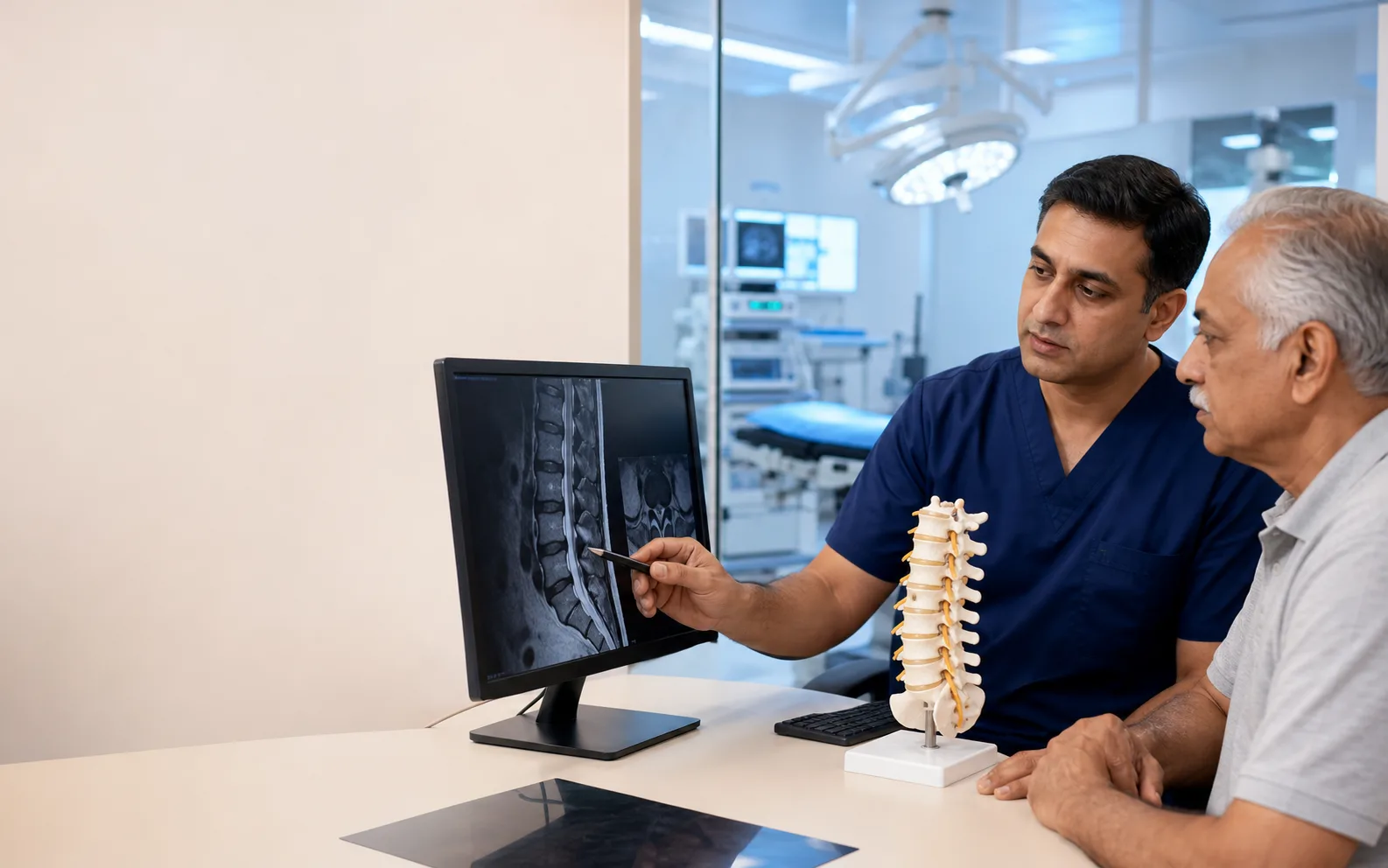
Endoscopic decompression is spine surgery, performed through a single incision typically under 1cm, using an endoscope (a thin tube with a built-in HD camera) to visualise and remove the bone, thickened ligament, or joint tissue that's narrowing the spinal canal and compressing a nerve root or the spinal cord. Unlike a discectomy, which targets herniated disc material, decompression targets spinal stenosis the bony and ligamentous narrowing that develops from degenerative changes, thickened ligamentum flavum, bone spurs (osteophytes), or enlarged facet joints. It's a more advanced, less invasive evolution of traditional open laminectomy, and patients sometimes refer to it simply as "keyhole surgery" for a narrowed spine.
Endoscopic lumbar decompression treats stenosis in the lower back (lumbar spine), the most common site for this procedure, often specifically at the L4-L5 level. Endoscopic cervical decompression addresses stenosis and foraminal narrowing in the neck. Both aim to create more room for the compressed nerve or spinal cord while preserving as much healthy surrounding bone, ligament, and disc tissue as possible.
These terms get used loosely, so it's worth being precise:
There are two main surgical approaches, and the right one depends on where your stenosis is:
Endoscopic decompression is generally considered when:
Endoscopic decompression is generally not suitable for:
This is exactly why an honest, thorough assessment matters more than jumping straight to a surgical opinion.
Before endoscopic decompression is ever discussed as an option, your evaluation should include a detailed history, a physical and neurological exam, and imaging MRI is the gold standard for visualising spinal stenosis and nerve or cord compression, with CT sometimes used for detailed bone anatomy, particularly around bone spurs and facet joints. At Nivaan, this diagnostic step, done properly by our interventional pain specialists, is what determines whether you're actually a surgical candidate or whether non-surgical care genuinely has more to offer you first.
At Nivaan, most patients with spinal stenosis do not need surgery. Our non-surgical approach typically includes:
If, after this genuine trial, your symptoms haven't improved, or if you have red-flag symptoms requiring more urgent action, we'll tell you plainly, and help you take the next step toward the right surgical opinion, rather than continuing non-surgical care past the point it's realistically going to help.
Endoscopic decompression surgery is typically performed under regional or general anaesthesia, in an operating theatre, by a spine surgeon:
The procedure usually takes 1-2 hours, and many patients go home the same day or after one night's observation.
Endoscopic lumbar decompression recovery time is one of the procedure's main advantages over traditional open laminectomy:
| Time | What to expect |
|---|---|
| First 24-48 hours | Light walking encouraged; rest otherwise |
| First week | Mild discomfort; pain medication as needed; avoid bending, twisting, or lifting |
| Weeks 2-4 | Physiotherapy typically begins; gradual increase in activity |
| Weeks 4-6 | Most patients return to desk-based work |
| Up to 3 months | Full recovery, including return to more strenuous activity, with your surgeon's clearance |
Endoscopic decompression side effects and risks are generally lower than open surgery but aren't zero: they can include infection, bleeding, nerve irritation, dural tears, incomplete symptom relief, recurrent stenosis at the same or an adjacent level, or, less commonly, the need for a further stabilisation procedure. Any surgeon discussing this procedure with you should walk through these honestly, not just the benefits.
You'll see specific success-rate percentages quoted across different clinics and hospitals online, often in the 80-90% range for meaningful improvement in leg symptoms and walking tolerance. These figures usually come from individual clinics' own case series rather than large, independent controlled trials, so treat any single confident percentage with some healthy scepticism. What's more reliably true across the evidence base: for well-selected patients with confirmed, appropriately located spinal stenosis who haven't responded to conservative care, endoscopic decompression has a strong track record of relieving neurogenic claudication and radiating leg or arm pain, with meaningfully faster recovery than traditional open laminectomy.
Endoscopic decompression cost in India typically ranges from roughly ₹1,20,000 to ₹3,00,000-plus, depending on the hospital, city, surgeon, number of levels treated, and whether a concurrent discectomy is required. This is a broad market indication, not a Nivaan-specific quote, since exact pricing depends on your individual case and the treating facility. If your assessment at Nivaan points toward needing surgery, we'll help you understand realistic cost expectations as part of that conversation.
If you're searching for endoscopic decompression in Delhi or the wider Delhi NCR region, the most important first step isn't picking a surgeon it's getting an accurate diagnosis of whether you actually need surgery at all. Nivaan's Gurugram clinic is where that conversation should start: a proper assessment from our interventional pain specialists, a genuine non-surgical trial where appropriate, and if surgery does turn out to be the right path, guidance toward it done for the right reasons, not as a default first option.
To be direct about what Nivaan does and doesn't do: our interventional pain specialists diagnose your condition, deliver non-surgical and interventional treatment (physiotherapy coordination, image-guided injections, and more), and give you an honest opinion on whether conservative care is working. Endoscopic decompression itself is a surgical procedure performed by a spine surgeon in an operating theatre. Where surgery is genuinely the right next step, we'll tell you clearly and support you in getting there, rather than either overselling non-surgical care past its usefulness or rushing you toward surgery it isn't yet time for.
Assessment at Nivaan Care starts with an accurate diagnosis, not a predetermined treatment path. Every patient is guided by a full multidisciplinary team:
Our approach is built around one principle: you deserve an honest answer about whether you need surgery, not a sales pitch in either direction.
Delhi
F-23, Nivaan, opposite Sri Aurobindo College, Geetanjali Enclave, New Delhi 110017
Dr. Rohit Gulati
Delhi
B-18, Nehru Place Flyover, Chirag Enclave, New Delhi 110048
Dr. Rohit Gulati
Delhi
25A, Block A1, Safdarjung Enclave, New Delhi 110029
Dr. Naveen Talwar
Delhi
CS/OCF-4, Pocket 10, Sector-24, New Delhi 110085
Dr. Garima Gupta
Delhi
67/1 New Rohtak Road, Guru Gobind Singh Marg, New Delhi 110005
Dr. Garima Gupta
Delhi
D-36, Block C, Acharya Niketan, New Delhi 110091
Dr. Abhimanyu Rana