





Delhi
Nivaan Pain Clinic, Malviya Nagar
F-23, Nivaan, opposite Sri Aurobindo College, Geetanjali Enclave, New Delhi 110017
Dr. Rohit Gulati


patients treated
advanced non-surgical procedures
years of combined expertise
Epidural Injection Treatment at Nivaan Care is a clinically proven, image-guided procedure that delivers anti-inflammatory steroid medication directly into the epidural space of the spine relieving nerve pain, sciatica, and chronic back pain without surgery. Whether you are looking for an epidural steroid injection for a herniated disc, spinal stenosis, or radiating leg pain, Epidural Injection Treatment in Delhi at Nivaan Care goes beyond a standalone injection to deliver a complete, specialist-led pain recovery plan.
Stop waiting for the pain to pass. Start treating the source.
An epidural injection, also called an epidural steroid injection (ESI), is a minimally invasive spinal injection that deposits a precise combination of corticosteroid and local anaesthetic into the epidural space: the narrow channel that surrounds the spinal cord and nerve roots inside the vertebral column.
The epidural space sits just outside the protective membrane (dura mater) encasing the spinal cord. When a disc herniates, a nerve root becomes compressed, or the spinal canal narrows (stenosis), the resulting inflammation causes intense pain that radiates along the path of the nerve into the leg as sciatica, into the arm, or across the back.
Epidural Injection Treatment at Nivaan Care delivers a corticosteroid directly to the site of this inflammation, suppressing the inflammatory cascade at the nerve root level and providing meaningful, often long-lasting pain relief, without surgery, without general anaesthesia, and without hospitalisation.
The mechanism behind epidural steroid injection is well established in the clinical literature. When a disc herniates, or a nerve root is compressed, the body releases inflammatory mediators including phospholipase A2 (PLA2), leukotrienes, and prostaglandins that sensitise the nerve root and cause radicular pain.
Corticosteroid (typically betamethasone, methylprednisolone, or dexamethasone) injected into the epidural space suppresses this inflammatory cascade directly at the source. It reduces oedema around the affected nerve root, decreases neural sensitisation, and interrupts the pain cycle, allowing the nerve to begin recovering and allowing the patient to engage meaningfully with physiotherapy and rehabilitation.
Local anaesthetic included in the injectate provides immediate pain relief that confirms correct needle placement and gives short-term comfort as the steroid begins working.
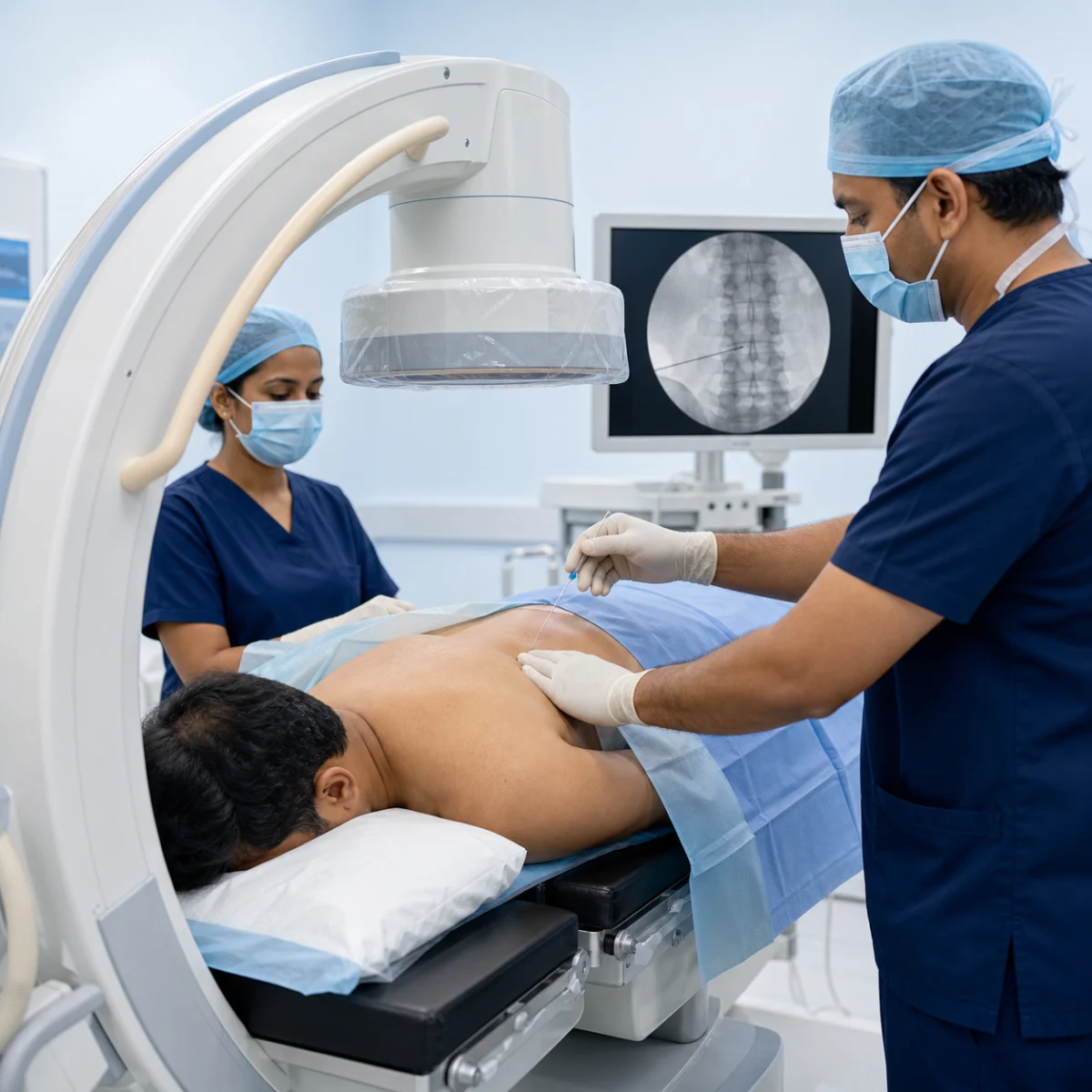
Critically, Epidural Injection Treatment at Nivaan Care is always performed under fluoroscopic or ultrasound image guidance by our Interventional Pain Specialists. Studies consistently show that without imaging guidance, up to 30–40% of epidural injections miss the intended target even in experienced hands. Image guidance at Nivaan ensures the medication reaches the exact epidural level where the inflammation is occurring not an approximation.
Epidural Injection Treatment in Delhi at Nivaan Care includes three image-guided approaches, selected based on your specific diagnosis, spinal level, and anatomy:
Interlaminar Epidural Steroid Injection: The needle is inserted between two adjacent vertebral laminae from the midline or slightly to one side (parasagittal). This is the most widely used approach for generalised disc-related back pain and bilateral symptoms. The interlaminar epidural steroid injection delivers medication across a broader area of the epidural space.
Transforaminal Epidural Steroid Injection (TFESI): The needle is directed into the intervertebral foramen, the opening through which the spinal nerve root exits the canal. The transforaminal epidural injection delivers steroid closest to the nerve root sleeve and ventral epidural space, making it the most targeted approach for single-level radiculopathy (sciatica from a specific disc level). TFESI injection has the strongest evidence base for single-nerve-root compression.
Caudal Epidural Steroid Injection: The caudal epidural injection accesses the epidural space via the sacral hiatus at the base of the spine. It is particularly useful for lower lumbar and sacral nerve root pain, post-surgical patients with altered anatomy, and elderly patients. The caudal epidural steroid injection is technically simpler and carries a low risk of dural puncture.
Your Interventional Pain Specialist at Nivaan will select the approach that best matches your imaging findings and pain pattern.
Epidural Injection Treatment in Delhi at Nivaan Care is recommended for nerve-related spinal pain conditions, particularly where physiotherapy, oral medications, or other conservative treatments have not provided lasting relief:
A specialist assessment at Nivaan determines whether Epidural Injection Treatment in Delhi is the right choice for your specific diagnosis and imaging findings.
Epidural Injection Treatment at Nivaan Care works best in carefully selected patients. It may be the right option if you have:
Epidural steroid injection is generally not recommended for patients with active spinal infection, uncontrolled bleeding disorders or those on anticoagulant therapy unable to pause it, uncontrolled diabetes (steroids elevate blood glucose), first-trimester pregnancy where fluoroscopy is involved, active cancer at the injection site, or patients with known allergy to corticosteroids or contrast dye. Your Nivaan specialist will review your full medical history and imaging before proceeding.
Epidural Injection Treatment at Nivaan Care requires clear preparation to ensure safety and effectiveness. Before your session, your Interventional Pain Specialist will:
Your Nivaan specialist will provide personalised preparation instructions at your consultation for Epidural Injection Treatment in Delhi.
Epidural Injection Treatment at Nivaan Care is minimally invasive and completed in a single outpatient session:
Step 1 Positioning: You are positioned lying face down (prone) on the procedure table with a pillow supporting your abdomen to open the spinal spaces.
Step 2 Sterile preparation: The injection site is thoroughly cleaned and draped under sterile technique. Skin and subcutaneous tissue are numbed with local anaesthetic.
Step 3 Image guidance setup: A fluoroscope (real-time X-ray) or ultrasound is positioned to provide live imaging of the spinal anatomy throughout the procedure.
Step 4 Epidural needle placement: The epidural needle is advanced under continuous image guidance to the precise epidural level. Contrast dye is injected to confirm the epidural space is correctly entered and to visualise the spread of injectate before the medication is given this is the critical safety step that separates image-guided ESI from freehand injection.
Step 5 Injection: The corticosteroid and local anaesthetic solution is slowly injected. The entire injection takes seconds; the procedure from start to finish typically takes 20–40 minutes.
Step 6 Recovery and discharge: You rest in the recovery area for 20–30 minutes. Most patients go home the same day.
A temporary increase in pain at the injection site or a brief flare in nerve symptoms in the 24–48 hours after an epidural steroid injection is normal it indicates the needle has been placed correctly and the medication is working. This is not a complication.
Avoid NSAIDs for 48 hours after the procedure. Use paracetamol (acetaminophen) for pain if needed. Avoid driving on the day of the injection if sedation was used. Resume light activity the following day. Avoid heavy lifting, vigorous exercise, and swimming for 48 hours.
Diabetic patients should monitor blood glucose closely for 3–5 days post-injection; corticosteroids cause a temporary but significant rise in blood sugar that requires management.
| Time | What to expect |
|---|---|
| Immediately after | Mild soreness at the injection site; possible temporary leg heaviness from local anaesthetic |
| First 24–48 hours | Possible brief pain flare as steroid begins working normal, not a complication |
| Days 3–7 | Local anaesthetic effect fades; steroid effect begins to build |
| Weeks 1–4 | Progressive reduction in nerve pain and radicular symptoms |
| Weeks 4–12 | Maximum steroid effect; window for active physiotherapy and rehabilitation |
| Months 3–6 | Duration of relief varies many patients maintain meaningful benefit for 3–6 months |
Epidural Injection Treatment at Nivaan Care is always combined with a structured physiotherapy programme. The injection provides the pain window; physiotherapy builds the strength and postural corrections that prevent recurrence. Learn about Nivaan's multidisciplinary approach →
Epidural steroid injection has a well-established safety profile across decades of clinical use.
Common and expected side effects:
Serious complications from epidural steroid injection, including nerve damage, spinal cord injury, or paralysis are exceptionally rare when the procedure is performed by an experienced Interventional Pain Specialist at Nivaan Care under image guidance.
Epidural steroid injection side effects related to systemic steroid absorption such as temporary fluid retention, mood changes, or menstrual irregularity are possible but generally mild given the small localised dose used.
Epidural injection cost in India varies depending on the approach used (interlaminar, transforaminal, or caudal), the spinal level treated, the number of levels injected per session, the type of corticosteroid used, and whether fluoroscopic image guidance is included.
Epidural Injection Treatment in Delhi at Nivaan Care is priced transparently. Your specialist confirms the full cost at consultation, including the approach recommended, the likely number of sessions, and the imaging protocol. Most patients require one to three sessions.
Epidural Injection Treatment in Delhi at Nivaan Care delivers meaningful pain relief for the majority of patients with nerve-related spinal pain. Clinical evidence shows that ESI provides significant short-term pain relief in at least half of patients, with many maintaining benefit for 3–6 months.
What to expect:
Responses vary. Transforaminal epidural steroid injection for acute single-level radiculopathy from disc herniation consistently shows the strongest outcomes. Caudal epidural steroid injection for lower lumbar and post-surgical pain and interlaminar epidural steroid injection for multi-level stenosis also show meaningful efficacy. Patients with chronic, long-standing compression or severe structural damage tend to see more limited benefit a specialist assessment will determine your suitability.
Epidural Injection Treatment at Nivaan Care is not a standalone injection. Every patient receives a complete, expert-led treatment plan built around their diagnosis, imaging, and recovery goals not a generic protocol.
At Nivaan Care, your epidural injection treatment is guided by a full multidisciplinary team:
Clinical evidence consistently shows that Epidural Injection Treatment in Delhi combined with targeted rehabilitation produces superior, longer-lasting outcomes compared to injection alone.
Delhi
F-23, Nivaan, opposite Sri Aurobindo College, Geetanjali Enclave, New Delhi 110017
Dr. Rohit Gulati
Delhi
B-18, Nehru Place Flyover, Chirag Enclave, New Delhi 110048
Dr. Rohit Gulati
Delhi
25A, Block A1, Safdarjung Enclave, New Delhi 110029
Dr. Naveen Talwar
Delhi
CS/OCF-4, Pocket 10, Sector-24, New Delhi 110085
Dr. Garima Gupta
Delhi
67/1 New Rohtak Road, Guru Gobind Singh Marg, New Delhi 110005
Dr. Garima Gupta
Delhi
D-36, Block C, Acharya Niketan, New Delhi 110091
Dr. Abhimanyu Rana